Revive & Restore Vintage
Original 1940s German Goatskin Kradmelder Motorcycle Jacket
Original 1940s German Goatskin Kradmelder Motorcycle Jacket
Couldn't load pickup availability
Dating from the 1940s, this original German goatskin motorcycle jacket is an exceptionally well-preserved example of wartime-era riding clothing. Its long belted silhouette, deeply overlapping asymmetric front and surviving German hardware place it firmly within the tradition of early motorcycle and dispatch-rider clothing.
Cut from substantial dark brown goatskin, the jacket has developed a superb natural patina over more than eighty years. Deep chocolate tones move into warmer brown and chestnut across exposed areas, while the distinctive natural grain of the goatskin gives the surface remarkable depth.
The shoulders, sleeves, pocket edges, seams and belt have each aged differently. Fine creasing, subtle rubbing, softened edges and individual markings remain visible throughout, creating a richly varied surface developed through more than eighty years of genuine age and use. Beneath this patina, the goatskin remains remarkably strong, supple and structurally sound.
Its most distinctive feature is the heavy asymmetric front closure. Rather than meeting conventionally at the centre, the substantial zipper sits well to one side, allowing the goatskin to overlap deeply across the torso when closed. The resulting double layer of leather across much of the chest is a particularly purposeful piece of early motorcycle construction.
The full leather waist belt draws the long body closely around the waist. Above it sits a broad leather turn-down collar and a distinctive arrangement of shaped shoulder and chest panels that gives the jacket its unmistakable period profile.
A vertical ZIPP-fastened breast pocket sits high on the chest, with two substantial shaped flap pockets positioned lower on the body. Period ZIPP hardware survives throughout, including the imposing asymmetric main zipper.
The original full leather belt retains its distinctive Gutoz PATENT metal fitting, another particularly good piece of surviving period hardware.
Hidden inside the sleeves are the original concealed storm cuffs, an unusual and purposeful detail that remains remarkably well preserved.
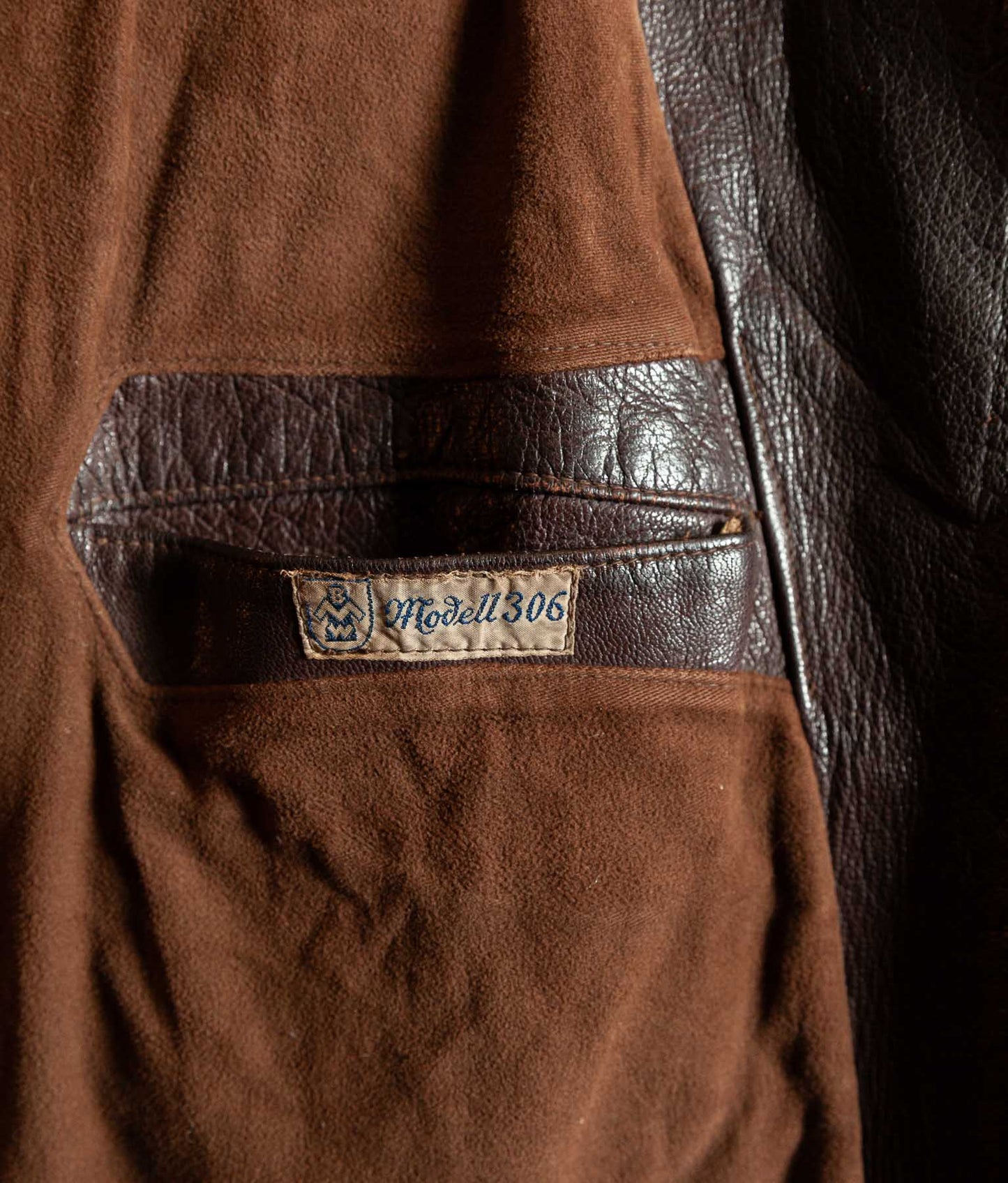
Inside, the original brown moleskin lining remains in place, together with an internal pocket and the original woven label bearing the Modell 306 designation.
The variations in colour, grain, creasing and wear have developed naturally through decades of genuine age and use.
More than eighty years on, it remains an unusually complete German motorcycle jacket, with the original goatskin, hardware and construction carrying the character of its age.
Condition & Preservation
Excellent vintage condition for its age.
The dark brown goatskin remains remarkably strong, supple and structurally sound, with pronounced natural grain and a deeply established patina.
The surface carries extensive genuine age and wear, including fine creasing, rubbing, small marks, softened edges and natural tonal variation. Deep chocolate tones give way to warmer brown and chestnut across the shoulders, sleeves, seams, pocket edges and belt. These characteristics are clearly shown in the photographs.
The jacket has been specialist cleaned and conditioned in-house, with particular care taken to preserve the original surface, grain and established patina of the goatskin.
The period ZIPP fasteners have been carefully refurbished, cleaned, waxed and polished and operate smoothly. The remaining metal hardware has also been carefully cleaned while retaining its age-developed appearance.
Two sympathetic replacement buttons have been fitted to the upper front flaps where the originals were missing. These were carefully selected to sit appropriately alongside the surviving period buttons and restore the intended appearance and function.
The original Gutoz PATENT belt fitting has a break to one side but remains functional and the belt can still be fastened. We believe we have a suitable period spare within our workshop stock and are attempting to locate it. If found, we will either undertake an appropriate repair or replacement before dispatch, or supply the spare fitting with the jacket for its new owner. The original Gutoz fitting will remain with the garment.
The original brown moleskin lining is exceptionally well preserved for its age. The internal pocket, woven label and concealed internal storm cuffs remain present.
All photographs show the actual jacket offered for sale and form an important part of the condition description.
Key Features
- Circa 1940s German construction
- WWII-era motorcycle / dispatch-rider design
- Kradmelder historical association
- Substantial dark brown goatskin leather
- Naturally developed patina
- Chocolate, brown and chestnut tonal variation
- Pronounced natural goatskin grain
- Long belted motorcycle silhouette
- Heavy asymmetric overlapping front
- Period ZIPP main zipper
- Additional period ZIPP hardware
- Vertical zipped breast pocket
- Two substantial shaped lower flap pockets
- Full leather waist belt
- Original Gutoz PATENT belt fitting
- Broad leather turn-down collar
- Shaped shoulder and chest panels
- Concealed internal storm cuffs
- Surviving period buttons
- Two sympathetic replacement buttons
- Original brown moleskin lining
- Internal pocket
- Original woven label
- Excellent vintage condition for its age
Garment Measurements, Laid Flat
- Chest, armpit to armpit: 22"
- Shoulders, seam to seam: 18"
- Sleeve, shoulder seam to cuff: 26"
- Sleeve, underarm seam to cuff: 18"
- Back length, collar seam to hem: 31"
Best suited to approximately a size S/M or 40" chest, depending on preferred fit and intended layering. For the best indication of fit, please compare the measurements above with a similar jacket you already own.