Revive Restore Vintage
Original WW2 1939 RAF Irvin Sheepskin Flying Jacket – Dot British Zips
Original WW2 1939 RAF Irvin Sheepskin Flying Jacket – Dot British Zips
Couldn't load pickup availability
Put it on and you’re wearing something older than almost everyone who will read this.
It’s late 1939 at an airfield somewhere in the east of England. A wooden hut, a stove going, a kettle that never quite stops. The crews sit in armchairs that don’t match, playing cards and listening for the telephone. Their flying kit hangs on the pegs by the door, ready to be pulled on in seconds.
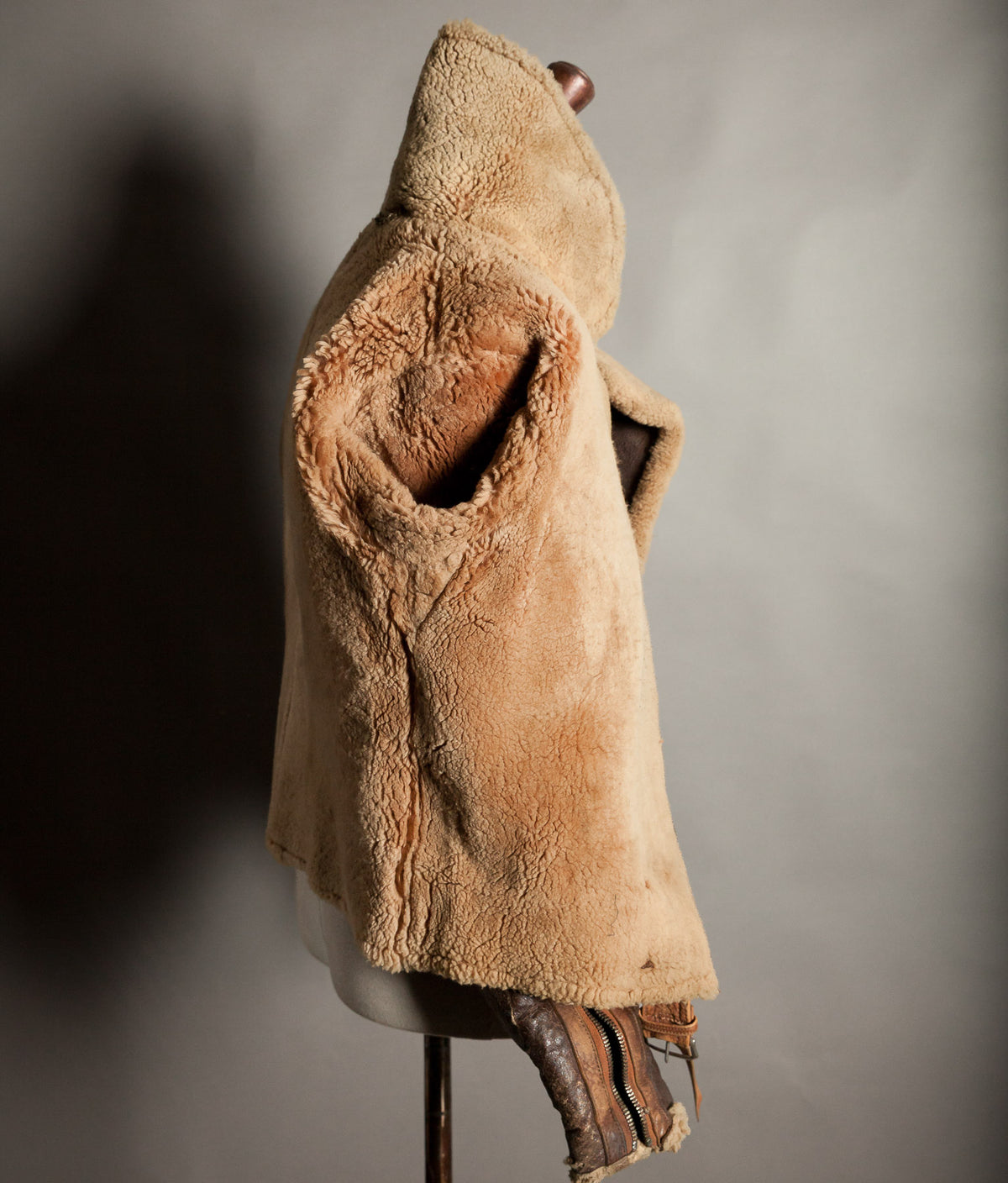
This is what hung there. Leslie Irvin, an American parachute pioneer with a factory at Letchworth, had worked out what a man needed at altitude in a draughty cockpit: sheepskin worn fleece-in, with the leather outside to keep off wind and wet. The collar turns up to cover the neck and lower face. A belt closes the waist against the draught. The forearms zip open so the jacket comes off fast over gloves and gear. Under each arm, a leather gusset is punched with eyelets so the body heat has somewhere to go. Nothing on it is decoration.
The Air Ministry took it up, and by the Battle of Britain jackets like this were being worn in Hurricanes and Spitfires. Within a few years the cost and the shortage of sheepskin meant they went mainly to bomber crews.
This one is early. The back is cut from a single seam down the middle, the way the first jackets were made before wartime shortages forced makers into smaller and smaller panels. The zips are the original Dot, the front stop stamped BRITISH. The belt is the original belt. By the look of the wear, it went on working after the war, quite possibly on the back of a motorcycle, which is where many of these ended up.
The leather has gone dark brown, crazed and soft, and lifted to tan along the bound seams. The fleece has toned to honey. Two old repairs at the back of the arm show somebody cared enough to mend it rather than throw it out.
Eighty-seven years on, it’s still by the door, waiting for whoever comes next.
Condition & Restoration
Very good condition for its age. The leather is sound and supple, with the crazing, surface wear and colour loss you’d expect on an original jacket of this period, most visible across the chest. There is an old stitched repair to the back of the left arm and a small one on a sleeve. Both are historic, sit at the back, and can’t be seen when the jacket is worn. They’re part of its character, and they’ve been left as they are.
The original 1939 Dot zips on the front and both sleeves had seized. All three have been cleaned and refurbished by hand in the workshop and now run smoothly. The original belt and buckle are present. The elastic strap that fitted round the back of the neck is missing, as it is on many surviving jackets. The fleece is full, with the natural toning of age.
The jacket has been carefully cleaned and the leather conditioned by hand in the workshop. Given its age, occasional wear and careful handling are recommended to help preserve it for years to come.
Key Features
- 1939 RAF Irvin sheepskin flying jacket
- Early single-seam back construction
- Period Dot zips to the front and sleeves, with DOT BRITISH-stamped front zip stop
- Thick sheepskin with naturally aged honey-coloured fleece
- Deep sheepskin collar with buckled leather throat strap
- Leather waist belt and buckle
- Zipped sleeves
- Underarm leather gussets with ventilation eyelets
- Leather-bound seams throughout
- Metal chain hanging loop inside the neck
Size & Fit
All measurements are taken with the garment laid flat.
- Chest (armpit to armpit): 22 in / 56 cm
- Shoulders (seam to seam): 19 in / 48 cm
- Sleeve (shoulder seam to cuff): 25 in / 63.5 cm
- Underarm seam to cuff: 19 in / 48 cm
- Back length (base of collar to hem): 22.5 in / 57 cm
Best suited to: a 38" to 40" chest.
Fit: Irvins are cut short and full in the body, to sit at the waist and allow movement in a cockpit. On a 38" chest there’s room for a jumper underneath. On a 40" it sits closer, as it was meant to. The belt lets you draw it in at the waist.