Revive Restore Vintage
German Kraftfahrer Interwar Leather Motoring Coat, 1920s–1930s, Forest Green
German Kraftfahrer Interwar Leather Motoring Coat, 1920s–1930s, Forest Green
Couldn't load pickup availability
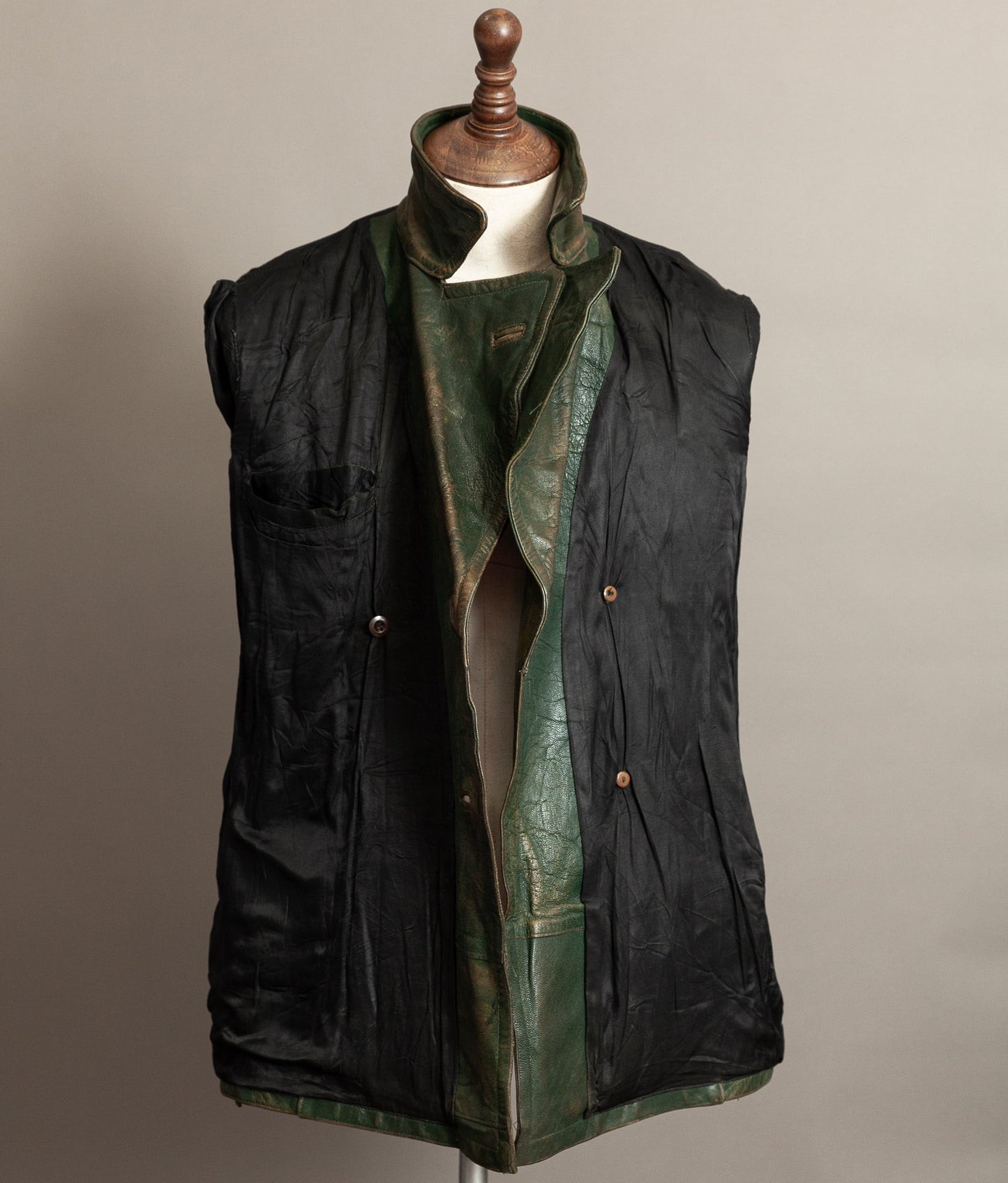
A German leather motoring coat in deep forest green, double-breasted and belted, almost certainly from the 1920s or early 1930s. The cut, construction, and hardware place it firmly in the tradition of purpose-built German outerwear for the Kraftfahrer, the motorist, garments designed to protect their wearer in open vehicles and to endure whatever was asked of them.
The word Kraftfahrer translates literally as motor driver, and the culture that produced this coat was one in which the relationship between man, machine, and road was still new and serious. Germany's leather garment industry had been supplying purpose-built outerwear to aviators and despatch riders since the First World War, when the German Air Force introduced brown leather flight jackets to protect pilots against cold at altitude, and motorcycle couriers relied on heavy leather coats to manage the exposure of open-air riding. By the early 1920s, as automobile ownership spread through the Weimar Republic's brief period of relative prosperity, the so-called Golden Twenties, civilian demand for similar garments grew with it. The open or semi-open motorcar required real protection from wind, rain, and cold. Goatskin, with its fine tight grain, natural water resistance, and strength relative to its weight, was a favoured choice of German and central European tanneries for exactly this kind of outerwear. Lightweight enough to wear, durable enough to last.
This coat carries every detail of that tradition. The front is double-breasted with a wide notch lapel, closeable to the throat via a single button at the collar for full protection against wind, or worn open in the manner of a civilian coat in milder conditions. The waist belt features a rectangular dark metal buckle with stitched edge detail, the leather of the belt itself faded through to warm tobacco brown where the dye has worn back from decades of use. The rear carries a horizontal elasticated panel at the waist, stitched into the lining and invisible from the outside, that cinches the coat to the body independently of the belt. This is a construction detail that speaks to how seriously the garment was designed to fit in motion.
The leather is a fine-grained goatskin, dyed in deep bottle green over a natural tan base. Time and use have drawn the colour back through the surface at every point of stress, across the shoulders, along the sleeve seams, at the cuffs and forearms, through the belt, revealing the warm brown beneath and producing a patina of extraordinary depth and variation. No two areas read the same. Goatskin ages differently to cowhide or horsehide, retaining more structural integrity across the panels even as the surface wears, and this coat bears that out. The surface has not been restored or artificially treated. What is visible is what the leather has become through time and use alone.
The coat is structured with raised vertical panel seams running down the front and sides, adding both body and formality to what is fundamentally a working garment. The sleeves are set with a characteristically square, structured shoulder of the period and taper to plain, unlined cuffs. Two shallow welt pockets sit at the lower front. The buttons are dark green plastic, well matched to the coat and replaced at some point during its working life. It is the kind of considered repair that speaks to how much this coat was used and valued by whoever owned it. The interior is lined throughout in a plain black satin fabric, present and intact, carrying only the light creasing consistent with its age.
For a coat of this age the condition is exceptional. The structure is completely solid, every seam is tight with no weakness, and the leather remains genuinely supple. It has survived a century of use in better shape than most garments manage in a decade.
The coat has been cleaned in house and given a light dressing to protect the hide without altering its surface character. All buttons and hardware are functional. The history is in the leather itself.
Key Details
- 1920s–1930s German leather Kraftfahrer motoring coat
- Goatskin hide, fine tight grain, naturally water resistant
- Double-breasted front with dark green plastic buttons, period replacement, well matched
- Wide notch lapels, open or buttoned close to throat
- Leather waist belt with rectangular dark metal buckle
- Elasticated rear waist panel, original and functional
- Raised vertical panel seams to front and sides
- Two lower front welt pockets
- Plain cuffs, unlined
- Black satin interior lining, present throughout
- Deep two-tone forest green and tobacco patina, unrestored
- All seams tight, structure completely solid
- All buttons and hardware functional
- Cleaned and lightly conditioned in house
Garment Measurements (Laid Flat)
- Chest (armpit to armpit): 21.5"
- Shoulders (seam to seam): 18"
- Sleeve length (underarm seam to cuff): 16"
- Sleeve length (shoulder seam to cuff): 24"
- Back length (collar seam to hem): 30"
Best suited to a 39" chest. As with all vintage garments, please measure a similar piece from your own wardrobe and compare against the measurements above before purchasing.