Revive & Restore Vintage
Vintage 1940s German Striwa Goatskin Leather Jacket, Belted Motoring Cut
Vintage 1940s German Striwa Goatskin Leather Jacket, Belted Motoring Cut
Couldn't load pickup availability
This is a German leather jacket from the 1940s, made by Striwa and cut from robust, pebbled goatskin in a deep bottle green. Decades of wear have brought the leather alive. Across the shoulders, collar, elbows and seams, the green has worn back to olive, sage and warm brown, while the protected areas still hold their original dark colour. Lift the collar or look beneath the belt and you can see exactly how it started out.
The wear tells you how it was used. The shoulders have weathered and lightened where they took the rain and daylight. The sleeves are deeply creased and softly burnished from years of movement. The collar points and raised seams have worn pale from handling. It’s honest, uneven wear that no modern distressing could copy, and it gives the jacket real character.
Striwa was one of the names that mattered in German leather clothing. The company was based in Lichtenfels, a small town in Upper Franconia in northern Bavaria, and its trademark covered leather and fur garments, gloves and outerwear. Collectors rank Striwa alongside Berolina and Hilbrecht as among the best-known German leather makers of the period. During the war the firm also made privately purchased leather greatcoats for officers. This jacket comes from the civilian side of that workshop.
In 1940s Germany a jacket like this was everyday working kit, not fashion. Leather jackets were worn by motorcyclists and despatch riders, by drivers and delivery men, and by tradesmen, foresters and estate workers who spent their days outdoors in all weathers. Green has long been the traditional colour of the German forester and hunter, and a bottle-green jacket like this would have looked as much at home in the woods as on the road. Leather was scarce and expensive, so a jacket like this was bought once and worn for life.
Every detail was there for a reason. The longer cut covers the lower back when you’re leaning forward on a motorcycle or bent over at work, where a short jacket rides up and lets the cold in. The broad collar turns up against wind and rain. The belt and the gathered back pull the jacket in tight at the waist, so the wind can’t blow up underneath it at speed. The buttoned flap pocket on the chest held papers, a licence or a wallet safely shut, and the two upright hand pockets are cut so they’re easy to reach while seated. The three-button cuffs close the sleeves at the wrist, and the warm plaid lining made it a jacket you could ride in through a German winter. It closes with its original German ZIPP metal zip, a make collectors associate with ZIPP-Werk of Nürnberg.
The maker added some style too. A straight-cut yoke runs across the front and back, edged with neat topstitching, and the chest pocket flap is cut to an angled point. The original leather belt closes with a matching leather-covered buckle.
Open it up and it’s a different jacket altogether. The body is lined in a bold woven plaid twill in teal green, sand and rust red, picked out with fine black stripes. Even the lining is gathered at the back waist to follow the shape of the leather. The sleeves are lined in a smooth sage-green twill with a soft sheen, and the original Striwa label sits on the chest, its name woven in green script. Against that dark green leather, it’s a striking combination.
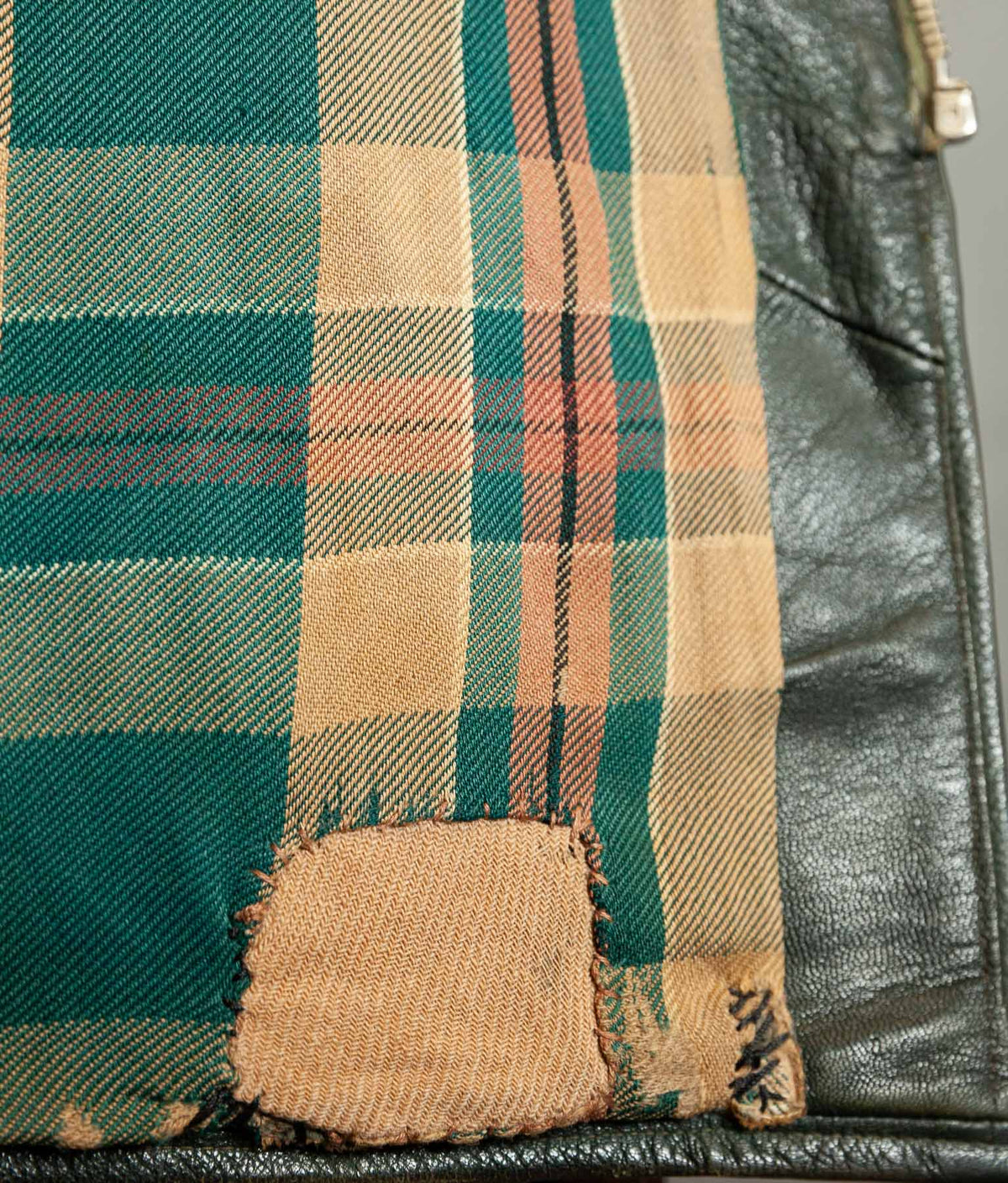
The lining has its own history. Over the years it has been carefully mended by hand: darned along the back of the collar, patched near the hem with a square of tan twill on one side and black satin on the other. Someone valued this jacket enough to keep it going, and those repairs have been left exactly as they were found.
Goatskin was the right choice for a jacket meant to last. It’s strong for its weight and naturally supple, with a close, pebbled grain that softens with age rather than wearing through. Eighty-odd years on, the leather is still sound and the jacket is well worn in the best sense.
A 1940s German Striwa jacket, with the whole of its working life written in the leather.
Condition & Restoration
Very good vintage condition for its age.
The goatskin is robust, supple and structurally sound, with extensive natural wear throughout. There’s surface wear and colour loss across the shoulders, collar, elbows, seams and edges, with deep creasing to the sleeves, all clearly shown in the photographs.
The original plaid lining is complete but shows its age. There are historic hand-sewn repairs along the back of the collar seam, a tan twill patch and a black satin patch at the lower front lining, and some fraying along the lining hem edge. These repairs are old and stable, and they’ve been deliberately kept as part of the jacket’s history rather than replaced. The sage-green sleeve linings are in good order.
The original belt and leather-covered buckle, the ZIPP front zip and the Striwa label are all present.
The leather has been specialist cleaned and conditioned in-house. It has not been recoloured or refinished, so the original green, the worn olive and brown tones, and the natural patina are all fully preserved.
Ready to wear or display.
Key Features
- Original 1940s German Striwa leather jacket
- Robust, pebbled goatskin in bottle green
- Rich, naturally worn olive and brown patina
- Original German ZIPP metal front zip
- Broad turn-down collar
- Front and rear yokes with topstitching
- Buttoned flap chest pocket
- Two upright welt hand pockets
- Original leather belt with leather-covered buckle
- Gathered rear waist
- Three-button cuffs
- Longer period cut
- Original Striwa woven label in green script
- Teal, sand and rust-red plaid twill body lining
- Sage-green twill sleeve linings
- Historic hand-sewn lining repairs, retained
- Specialist cleaned and conditioned in-house, not recoloured
Garment Measurements, Laid Flat
- Chest, armpit to armpit: 22" / 56 cm
- Shoulders, seam to seam: 19" / 48.5 cm
- Sleeve, shoulder seam to cuff: 25.5" / 65 cm
- Underarm seam to cuff: 16.5" / 42 cm
- Back length, base of collar to hem: 29" / 73.5 cm
Best suited to: 40" chest, regular / Size S–M
Fit: A true 1940s cut, drawn in at the waist by the belt and gathered back, with the longer body typical of the period sitting well below the hip. Please refer to the measurements above, and for any questions about sizing, please get in touch.